

Is It Cheaper to Book Two One-Way Tickets vs a Round Trip? Here’s the Real Answer
You’ve probably stared at a flight booking screen at some point, wondering whether to book two one-way tickets vs a round trip. The prices look different, the logic feels confusing, and you’re not sure which option actually saves you more money. It’s one of the most common questions travellers ask before booking, and the honest answer is: it depends — but knowing what it depends on will help you make the smarter call every time.
This post breaks it all down clearly, so you can stop guessing and start booking with confidence.
Two One-Way Tickets vs Round Trip: What’s the Actual Difference?
A round trip ticket is a single booking that covers both your outbound and return flights. You buy it in one transaction, usually from the same airline, and both legs of the journey sit together under one booking reference.
Two one-way tickets means you book each flight separately. Your JFK to LHR leg is one booking, and your LHR to JFK return is a completely different booking — possibly with a different airline, through a different platform, at a different price.
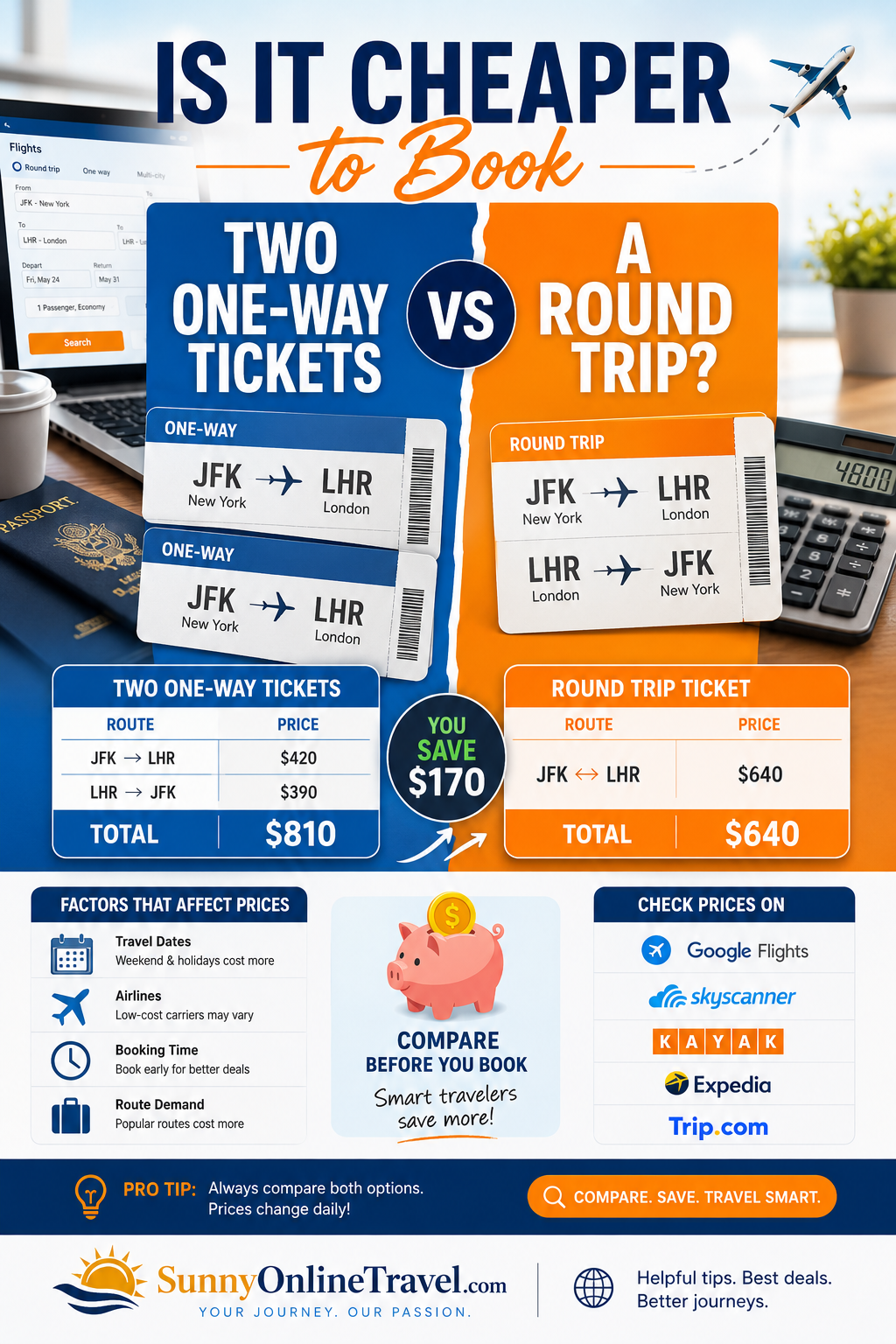
The infographic above makes this crystal clear using a real-world example. Two one-way tickets on the JFK to LHR route cost $420 and $390 respectively, bringing your total to $810. The round trip on the exact same route costs $640. That’s a saving of $170 by choosing the round trip. On this particular route and at these prices, the round trip wins comfortably.
But here’s the thing: that’s just one example. The numbers flip depending on several factors, and understanding those factors is what makes the real difference.
When a Round Trip Ticket Is Cheaper
Airlines price round trip tickets to encourage commitment. When you book both flights together, the airline secures your return business upfront. They reward that with a bundled discount. This is especially common on major international routes where competition is high and airlines fight for market share.
On routes like New York to London, Paris, or Dubai, round trip fares are frequently lower than the combined cost of two separate one-way tickets. The same applies to many domestic routes in the US, UK, and Australia. If you know your return date, booking a round trip on these routes is almost always worth pricing first.
Seasonal demand plays a big role too. During peak periods, one-way fares spike individually while round trip prices often hold steadier because airlines price them to attract holiday travellers booking well in advance. If you’re travelling over Christmas, summer school holidays, or Easter, run the round trip price first before assuming two separate tickets will be cheaper.
When Two One-Way Tickets Can Save You Money
Here’s where it gets interesting. Two one-way tickets beat a round trip in more situations than most people realise.
Low-cost carriers have changed the pricing game entirely. Budget airlines like Ryanair, easyJet, Spirit, and Frontier typically sell only one-way tickets by default. If you’re flying from London to Barcelona outbound with British Airways and returning with Ryanair, there’s no round trip to book. You’re buying two separate one-way tickets whether you like it or not — and your total might still undercut the British Airways round trip fare.
Mixing airlines is also a smart tactic when one carrier heavily discounts a specific route. Maybe Delta prices the LHR to JFK return leg much lower than the airline you used for the outbound leg. Booking separately lets you cherry-pick the cheapest fare for each direction rather than accepting whatever the round trip airline charges for the return.
And then there’s flexibility. If you don’t have a fixed return date, booking your return separately later can save you from paying change fees. Round trip tickets often come with restrictions. Change fees, date lock-ins, and non-refundable fares can turn that initial saving into a cost if your plans shift. Two one-way tickets give you the freedom to book the return when you’re ready.
SunnyOnlineTravel’s guide on why one-way tickets are changing how we travel goes deeper into this shift and is worth reading if you travel frequently or like keeping your plans open.
The Four Factors That Determine Which Option Wins
The infographic highlights four key factors that affect pricing, and each one genuinely shifts the answer.
1. Travel Dates
Weekends and public holidays push one-way fares up sharply. If your outbound flight falls on a Friday and your return on a Sunday, those are peak days and the individual one-way prices will reflect that. A round trip booked on the same dates may bundle that cost differently and come out lower. Mid-week travel typically offers cheaper one-way fares, which can make two separate tickets more attractive.
2. Airlines and Low-Cost Carriers
Full-service airlines (British Airways, Emirates, Lufthansa, Delta) tend to offer competitive round trip discounts. Low-cost carriers often don’t. If your route involves even one budget airline in either direction, check both options. You might find that mixing one full-service and one budget carrier for your two legs beats any available round trip.
3. Booking Time
Book early and you generally save money on both options. But early booking rewards round trips slightly more, because airlines release their best round trip inventory first. If you book last-minute, one-way fares sometimes become surprisingly cheap as airlines try to fill empty seats — so two one-way tickets can occasionally work in your favour close to departure. As a general rule though, booking more than six weeks out gives you the best chance of a good deal either way.
4. Route Demand
Popular routes cost more. JFK to LHR is one of the most competitive routes in the world, which is why the round trip pricing in the example above is so aggressive. On less-travelled routes where airlines face less competition, round trip discounts shrink and two one-way tickets sometimes come out cheaper simply because you can mix carriers that wouldn’t ordinarily serve the full round trip together.
The Hidden Cost People Forget About
Price isn’t the only number that matters. Think about what happens if your outbound flight is cancelled or severely delayed.
With a round trip, both legs are on the same booking. The airline takes responsibility for sorting out your disruption, including the return leg if necessary. You have one point of contact and one contract.
With two separate one-way bookings, each ticket is its own independent contract. If your outbound flight is disrupted and you miss time at your destination, your return ticket isn’t affected — you’ll still pay to change it if you need to shift the date. Airlines owe you nothing on a separate booking just because another airline caused you a delay.
This doesn’t mean two one-way tickets are always the riskier choice, but you should factor in travel insurance if you go that route. A policy that covers missed connections and flight disruptions gives you a safety net whether you’re holding one booking or two. SunnyOnlineTravel’s airport tips guide covers how to prepare for disruptions and keep your travel smooth from the start.
How to Compare Both Options Properly
Most people make one mistake here: they check the round trip price on one platform and the one-way prices on another, then compare numbers that aren’t equivalent. You need to compare apples to apples.
Here’s the right way to do it.
First, search the round trip price on Google Flights for your exact dates. Note the total. Then, in a separate search, price your outbound one-way fare. Then price the return one-way fare. Add them up. Compare the two totals.
Do this across at least two or three platforms. The infographic recommends Google Flights, Skyscanner, Kayak, Expedia, and Trip.com, and that’s solid advice. Different platforms surface different inventory, and the cheapest fare for one leg might not appear on the same site as the cheapest fare for the other.
Google Flights is particularly good for this because its calendar view lets you see price patterns across dates, so you can quickly spot whether flying a day earlier or later on either leg saves you money. Skyscanner’s Everywhere search is excellent if you have some flexibility and want to see which destination combination gives you the best deal overall.
The key habit is to check both options every single time, for every trip, rather than assuming one method is always cheaper.
A Real Scenario Where Two One-Way Tickets Win
Imagine you want to fly from London to Lisbon for a long weekend. You check British Airways and their round trip comes to £210. Then you notice Ryanair flies the outbound leg for £29, and TAP Air Portugal flies the return for £55. That’s £84 total for two one-way tickets — a saving of £126 over the round trip.
This kind of scenario plays out regularly on short-haul European routes where low-cost carriers dominate. It also happens on certain transatlantic and intra-Asian routes where budget carriers have expanded aggressively. The savings aren’t always that dramatic, but even £20 to £40 in your pocket is worth five minutes of comparison shopping.
What About Documents and Entry Requirements?
One more practical point that often gets overlooked: some countries require you to show a return or onward ticket on arrival. If you book two one-way tickets and travel outbound first, you’ll need to show your return booking if immigration asks. Always carry both booking confirmations when you travel on separate one-way tickets.
If you’re uncertain about what documents you need for your specific journey, SunnyOnlineTravel’s guide to what documents you need for a one-way flight covers this thoroughly, including which countries are most likely to ask for proof of onward travel.
Two One-Way Tickets vs Round Trip: The Verdict
Neither option wins outright. The round trip is often cheaper on major international routes, especially with full-service airlines. Two one-way tickets win when you mix carriers, fly low-cost routes, need flexibility, or spot a significant price difference on individual legs.
The travellers who consistently pay less for flights are not the ones who always book one type over the other. They’re the ones who check both options every time and pick the cheaper total.
There’s no loyalty to round trips or one-way tickets worth having. Your only loyalty should be to your own wallet.
For longer or more complex journeys, Kayak’s price forecasting tool can tell you whether fares on your route are likely to rise or fall before you commit, which adds another layer of confidence to your decision.
Your Practical Next Step
Right now, before your next trip, open Google Flights and search your route as a round trip. Write down the total price. Then search the outbound leg as a one-way fare, and the return leg as a separate one-way fare, and add them together. Run the same exercise on Skyscanner. You’ll have a direct comparison in under ten minutes. Whichever total is lower, book that. Do this consistently and you will save real money on flights over the course of a year — not once, but every time you fly.


