
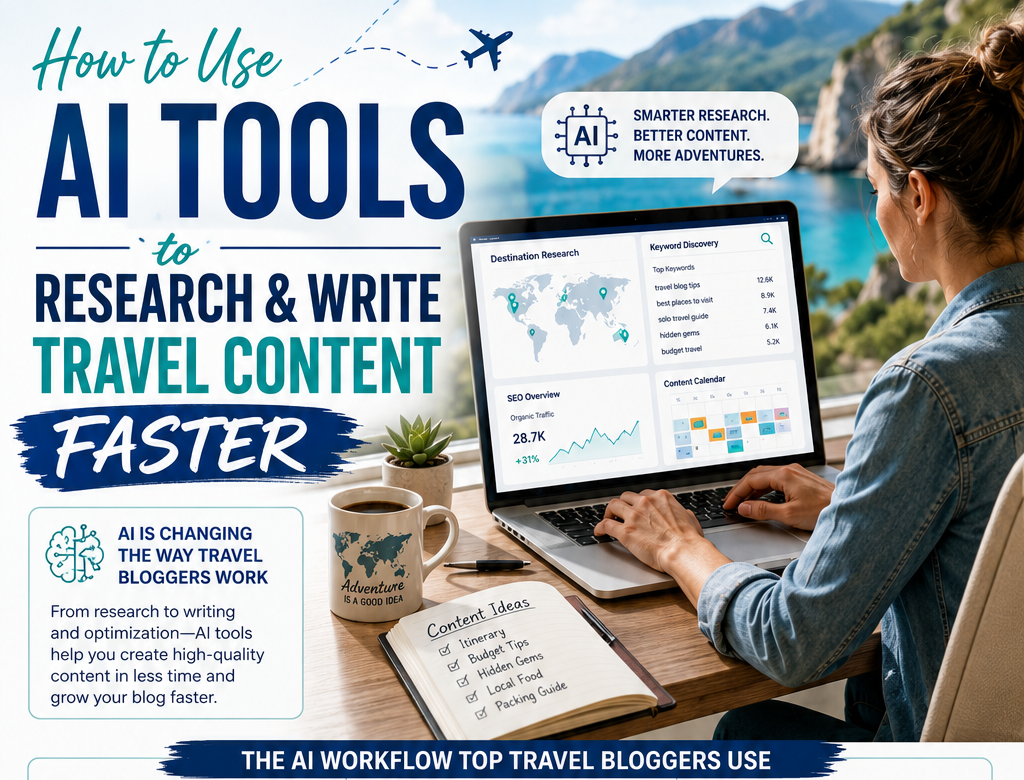
How to Use AI Tools to Research and Write Travel Content Faster
Writing a travel blog post used to take most of a day. You would spend hours researching a destination, hunting for keyword ideas, wrestling with a structure, writing a draft, fact-checking your stats, finding images, and then doing it all again for the next post. The content calendar never gets shorter. The ideas list does not shrink. And real life, which includes actually travelling, keeps getting in the way.
AI tools for travel bloggers have changed this workflow completely. The smartest travel creators are now using AI to handle the research-heavy, structure-heavy parts of the process so they can spend more time on what only they can do: sharing their genuine experience, their perspective, and their voice. This post walks you through the exact AI workflow that top travel bloggers use across six areas: destination research, keyword discovery, content outlines, fact-checking, image generation, and SEO optimisation.
Why AI Tools Are Changing How Travel Bloggers Work
The case for using AI in your travel blog workflow is not about replacing your writing. It is about removing the friction that stops you from writing consistently. Most bloggers who struggle with output are not short on ideas. They are short on time and energy, and they spend too much of both on tasks that do not require a human touch.
AI handles those tasks well. It can scan dozens of sources for destination information in seconds. It can generate keyword ideas based on real search data. It can produce a solid post outline before you have even made your coffee. What it cannot do is tell your reader about the moment you got genuinely lost in Lisbon and ended up finding the best pastry you have ever tasted. That part is still yours. Always.
The workflow below treats AI as a capable research and structure assistant, not a ghostwriter. That distinction matters. Readers can feel the difference between a post that a person lived and shaped compared to one that an algorithm assembled. Your job is to use AI for the drafting and then fill it with your real experiences.
Step One: Destination Research With AI Tools
Before you write a single sentence, you need to know your destination well enough to say something useful about it. For somewhere you have visited, that knowledge comes from memory and notes. For somewhere you plan to cover in advance, or want to supplement your own experience with practical detail, AI research tools speed up the groundwork significantly.
You can ask an AI tool to pull together the practical essentials for any destination: visa requirements, best time to visit, how to get there, currency information, local customs, and trending experiences travellers are talking about right now. What takes an hour of tab-hopping through government websites, travel forums, and tourism boards can come back in a few seconds.
How to Use AI Tools for Destination Research Without Losing Your Voice
Use AI to gather the facts. Use your own experience to interpret them. Ask it questions like: “What are the most common practical questions first-time visitors to Vietnam ask before they go?” or “What aspects of Morocco do budget travellers most frequently search for?” The answers give you a research starting point, not a finished post.
Cross-check anything time-sensitive, especially visa rules, entry requirements, and transport details, because AI tools have knowledge cutoffs and travel information changes frequently. More on that in the fact-checking section below.
Step Two: Keyword Discovery for Travel Blog SEO
This is where AI genuinely earns its place in your workflow. Finding low-competition, high-value keywords that your specific audience is actually searching for used to require either expensive tools or a lot of guesswork. AI tools make it much faster to generate keyword ideas, cluster them by intent, and identify which ones make sense for your blog’s current authority level.
Start by giving an AI tool your destination and your audience type. Ask for keyword ideas that combine a specific location with a specific traveller need. “Solo travel tips Japan,” “budget travel Europe first time,” and “hidden gems Southeast Asia backpacker” are the kind of specific, searchable phrases that bring in targeted readers rather than passive scrollers.
The Keywords That Actually Move the Needle
Long-tail keywords consistently outperform broad ones for travel blogs that are still building domain authority. A post targeting “best places to visit in Europe” will struggle to rank for years against established travel publishers. A post targeting “best places to visit in Europe for first-time solo travellers in autumn” has a much more realistic path to page one.
According to Ahrefs’ travel blog research, travel blogs that focus their early content on specific long-tail phrases grow organic traffic significantly faster than those chasing high-volume competitive terms. AI tools are particularly useful here because they can generate dozens of long-tail variations in seconds, giving you a content calendar full of rankable ideas rather than aspirational ones.
For a deeper look at the content strategy side of travel blogging, the SunnyOnlineTravel travel tips section has practical resources worth exploring.
Step Three: Content Outlines That Kill Writer’s Block Instantly
Writer’s block for travel bloggers rarely comes from having nothing to say. It comes from not knowing where to start. A blank document with a post title at the top is genuinely paralysing for a lot of writers, even experienced ones. AI outlines solve this problem in under a minute.
Give your AI tool the post title and your target keyword, and ask it to generate a detailed blog post outline with specific subheadings. A good prompt looks like this: “Create a detailed outline for a travel blog post titled ‘One Week in Portugal: The Perfect Itinerary for First Timers.’ Include sections on getting there, where to stay, day-by-day itinerary, budget breakdown, and practical tips. Write for a reader who has never been to Europe before.”
What a Good AI Outline Gives You
A solid AI-generated outline gives you a logical flow, a list of topics to cover, and a sense of the post’s scope before you write a word. You will likely move sections around, cut some, and add others based on your actual experience. That editing process is far faster than starting from nothing, and it stops the dreaded blank-page paralysis before it starts.
Think of the outline as a suggested route. You know the destination, the AI suggested some roads, and now you decide which ones actually fit your journey.
Step Four: Fact-Checking Your Travel Content
This is the step that separates good travel bloggers from careless ones, and it is where AI needs the most human supervision. AI tools generate plausible-sounding information very confidently, including information that is outdated, incorrect, or simply made up. In travel content, wrong facts have real consequences. A reader who follows your advice about visa requirements or currency exchange and gets it wrong will not come back to your blog.
Use AI to surface information quickly, then verify anything that really matters through official sources. Visa requirements, entry rules, opening hours, prices, and transport schedules all need human cross-referencing before they go in a published post.
Building a Fact-Checking Habit Into Your Workflow
Create a simple habit: every time you include a specific fact, stat, or practical detail in a post, highlight it. Before you hit publish, go through each highlight and verify it through a primary source, the official tourism board website, a government entry requirements page, or a current news source. This takes ten minutes on a finished post and saves you from publishing something that misleads your readers.
The reputation you build as a reliable, accurate travel resource is one of your most valuable long-term assets. Travel blogging SEO research from Promodo consistently shows that content accuracy and user trust signals directly influence how long readers stay on your site, which feeds into your Google rankings. AI helps you write faster. Fact-checking helps you write better.
Step Five: Image Generation for Travel Content
Stock photos for travel blogs are a minefield. The same images appear on hundreds of sites. They look generic. They rarely match the specific mood or destination detail your post actually needs. AI image generation tools are changing this, and for travel bloggers, the possibilities are genuinely exciting.
Tools like Midjourney, Adobe Firefly, and DALL-E 3 let you generate custom images from text prompts. You describe what you want, and within seconds you have an original image that no other blog uses. A prompt like “sunrise over a mountain lake, travel photography style, warm golden light, misty water, no people” gives you something atmospheric and specific to your post.
Where AI Images Work Best for Travel Blogs
AI-generated images work particularly well for featured graphics, Pinterest pin backgrounds, and illustrative images for concepts rather than specific places. For destination-specific content, your own photography will always feel more authentic and more trusted. But for social media graphics, email headers, and general travel concept imagery, AI image tools save you significant time and money on stock photography subscriptions.
Always disclose when you use AI-generated images in your content. Your readers trust you to be transparent, and that transparency is worth more than any shortcut.
Step Six: SEO Optimisation With AI Tools
Once your post is written, AI tools can help you analyse and improve it for search. Several tools, including Surfer SEO, Clearscope, and RankMath’s AI features, assess your content against the top-ranking pages for your target keyword and tell you what is missing, what is overrepresented, and where your on-page SEO has gaps.
The core on-page SEO checklist for any travel blog post covers five things: your target keyword in the title and first paragraph, a natural keyword appearance in at least one subheading, a strong meta description that actually describes the post’s value, internal links to other relevant posts on your blog, and properly structured header tags (H1, H2, H3) that help Google understand your content hierarchy.
Using AI to Audit Your Existing Posts
One of the highest-value uses of AI for established travel bloggers is auditing older posts. You can paste an existing post into an AI tool and ask it to identify missing sections, suggest stronger subheadings, flag thin content sections, and recommend internal linking opportunities. An hour of AI-assisted auditing on your ten most-visited older posts can produce more traffic growth than writing five new ones from scratch.
According to research from Travel Blogging 101, updating and strengthening existing posts is one of the most underused growth strategies in travel blogging, and AI makes the audit process fast enough that it is no longer a daunting task.
For bloggers looking to monetise that growing traffic, How to Make Money as a Travel Blogger covers how to turn consistent search traffic into sustainable income streams.
Putting the AI Workflow Together
The six steps above work best as a connected workflow rather than isolated tasks. Here is how a typical AI-assisted travel post comes together:
You start with destination research to gather the practical backbone. You run keyword discovery to find the right angle and search term. You prompt an AI tool for an outline and refine it based on your actual experience. You write your draft, weaving in your personal stories, opinions, and observations throughout. You fact-check the specifics before you publish. You generate any supporting graphics you need. Then you run a final SEO audit to make sure the post is doing everything it can for your Google rankings.
Done this way, a post that used to take a full day now takes two to four hours. The time you save goes back into doing the things AI cannot do: travelling more, observing more, experiencing more, and writing with the kind of specificity and honesty that makes readers genuinely trust you.
If you are still in the early stages of building your blog and want to understand the full picture before you build out your content workflow, How to Start a Travel Blog: A Step-by-Step Guide covers the foundations in a clear, practical way.
Practical Actionable Tips You Can Apply Right Now
Here are five things you can do today to start using AI tools in your travel blog workflow:
1. Test one AI tool on your next post’s research phase. Before you write your next post, open ChatGPT, Claude, or Gemini and type: “What are the most common practical questions first-time visitors to [your destination] ask before they go?” Use the output as your research starting point, then verify the key facts through official sources before you publish.
2. Generate five long-tail keyword ideas for your next destination. Ask an AI tool to give you ten specific, searchable keyword ideas for your next travel topic, aimed at your exact reader type. Save the ones that feel right. Use one as your primary keyword for the next post and keep the rest for future content ideas.
3. Prompt an outline before you write anything. The next time you sit down to write a post, spend the first five minutes getting an AI outline first. Give it your topic, your keyword, and your target reader. Refine the outline to match your experience. Then write into the structure rather than starting from a blank page.
4. Audit your three most-visited old posts. Paste each one into an AI tool and ask: “What is missing from this travel blog post that a reader would expect to find? What subheadings could be stronger? What internal linking opportunities am I missing?” Make the suggested improvements and republish. Track your traffic over the next thirty days.
5. Generate a custom Pinterest graphic with an AI image tool. Pick a post that already performs well on your blog and use an AI image tool to generate a fresh, custom graphic for it. Use it to create a new Pinterest pin. Compare the performance of the AI-generated image against your standard pin format over the next two weeks.
Smarter research. Better content. More adventures. That is the promise of a well-built AI workflow, and it is one that travel bloggers who adopt it early are already seeing in their traffic and output. The tools exist. The workflow is straightforward. What you do with the time you get back is entirely up to you.
Ready to get started? Pick one of the five tips above and put it into practice before you close this tab. One step today builds a better content workflow tomorrow.
More from SunnyOnlineTravel: Travel Tips and Resources | How to Start a Travel Blog | How to Make Money as a Travel Blogger


