
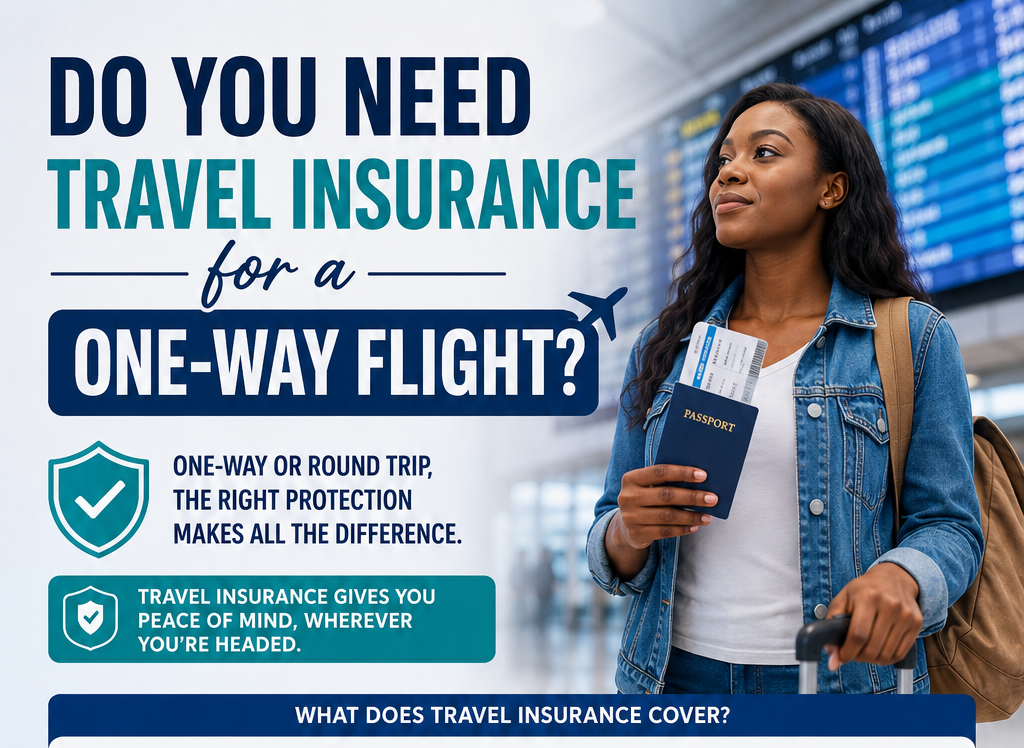
Do You Need Travel Insurance for a One-Way Flight? Here’s What You Should Know
You’ve booked your one-way flight. You’ve sorted your accommodation, packed your bags, and triple-checked your passport. But then someone asks: “Did you get travel insurance?” And suddenly you’re not sure. Do you need travel insurance for a one-way flight? Is it even worth it? The short answer is yes — and this post explains exactly why, what it covers, and how to pick the right policy so you travel protected rather than just lucky.
Why Travel Insurance for a One-Way Flight Is Different
When you book a round trip, the airline holds some responsibility for both legs of your journey under the same booking. A one-way flight changes that equation. You’re stepping off that plane with no guaranteed return ticket, no airline obligation to sort you out if things go wrong at the destination, and in many countries, no safety net beyond what you’ve personally arranged.
That gap matters more than most people realise. If you fall sick abroad on a round trip, your insurer and your airline are both in the picture. On a one-way trip, once that plane lands, you’re operating entirely on your own terms. That’s a great feeling when everything goes to plan. It becomes a very expensive problem when it doesn’t.
The right travel insurance policy fills that gap. It protects you from the costs that hit hardest when you’re away from home with no return flight to fall back on.
What Travel Insurance Actually Covers for One-Way Travellers
A good travel insurance policy covers five main areas that matter directly to one-way travellers.
Emergency Medical Expenses — The Biggest Reason to Buy Travel Insurance for a One-Way Flight
This is the one that saves people the most money. Medical costs abroad are genuinely staggering. A single night in a US hospital can run to thousands of dollars. Emergency treatment in parts of Southeast Asia, while cheaper, still clocks up bills that most travellers aren’t prepared to pay out of pocket. A broken leg, an allergic reaction, appendicitis — none of these come with a warning, and none of them are cheap.
Your domestic health insurance, if you have it, very likely does not cover you abroad. Some policies offer limited international coverage; most offer none at all. Travel insurance covers emergency medical treatment, hospitalisation, and in serious cases, medical evacuation back to your home country. That last one alone can cost $50,000 to $100,000 without insurance. You read that correctly.
Trip Cancellation Before You Fly
Even before your flight departs, things can go wrong. A family emergency, a sudden illness, a bereavement. Trip cancellation cover reimburses your non-refundable costs if you have to cancel before you leave. On a one-way flight, your ticket is often the biggest upfront cost, and airlines rarely offer full refunds. Getting that money back when life intervenes is one of the most practical reasons to buy insurance before you travel.
Trip Interruption After You Land
Trip interruption cover kicks in when your journey gets cut short unexpectedly after it has already begun. Maybe a family crisis calls you home early. Maybe a natural disaster affects your destination. Whatever the reason, interruption cover reimburses your additional costs and unused bookings when you have to change plans mid-trip. For one-way travellers especially, who often have accommodation, tours, or onward connections booked ahead, this cover can prevent significant financial losses.
Lost, Delayed, or Stolen Baggage
Your luggage goes missing more often than airlines would like to admit. Bags get delayed, misrouted, or in the worst cases, stolen. When you’re on a one-way trip, particularly if you’re relocating or travelling long-term, your bag likely contains more of your essentials than a short holiday bag would. Baggage cover compensates you for the value of lost or stolen items and covers emergency purchases if your luggage is delayed by more than a set number of hours. The payout won’t replace everything, but it takes the sting out of arriving somewhere new with nothing but the clothes on your back.
24/7 Travel Assistance
This is the often-overlooked benefit that becomes invaluable in the middle of a crisis. Quality travel insurance policies give you access to a 24/7 helpline staffed by people who can assist with emergency medical referrals, legal support, lost passport advice, and emergency cash transfers. When you’re in a foreign country at midnight and something has gone badly wrong, having a number to call and a team to help is worth far more than the policy premium.
Three Specific Reasons One-Way Travellers Need Travel Insurance More, Not Less
1. You Have No Return Ticket as a Backup
Round trip travellers have a built-in exit plan. If things go wrong, that return flight is waiting. One-way travellers don’t have that option. Any costs involved in getting home early — buying a new flight at short notice, rebooking onward connections, covering extra nights somewhere — fall entirely on you. Travel insurance covers those emergency return costs. Without it, you foot the entire bill at whatever price the airline charges for a last-minute fare.
2. Medical Costs Abroad Fall Entirely on You
As a one-way traveller, you may have already cancelled or paused your home country’s health coverage. Even if you haven’t, most domestic health policies simply don’t extend abroad in any meaningful way. This leaves you personally liable for every medical expense you incur at your destination. One hospitalisation without insurance can cost more than years’ worth of travel insurance premiums. The risk is not theoretical — it’s one of the most common and costly situations that travellers face.
3. Unexpected Events Don’t Discriminate
Travelling one-way often means longer trips, more destinations, and more time exposed to the unpredictable. The longer you travel, the more opportunities there are for something to go sideways. A delayed flight causes you to miss an onward connection. Your passport gets stolen in a busy market. A storm grounds all flights for three days. None of these are dramatic edge cases — they happen to ordinary travellers every single week. Insurance keeps them from becoming financial disasters.
SunnyOnlineTravel’s guide to why one-way tickets are changing how we travel has a great breakdown of what the shift to one-way travel actually means for how you plan and protect your trips.
How to Choose the Right Travel Insurance for a One-Way Flight
Not all travel insurance policies work the same way. Buying the right one requires a few specific checks.
Check whether the policy covers one-way travel. Some policies are written assuming you have a return ticket and a definite end date. If your trip is open-ended or long-term, make sure the policy you choose explicitly covers this. Look for policies marketed to long-term travellers, digital nomads, or backpackers, as these tend to be built around open-ended travel.
Look at the medical coverage limit carefully. For international travel, you want a minimum of $100,000 in emergency medical coverage. If you’re heading to the US, Canada, or Australia, aim for $500,000 or higher. Medical costs in these countries are extremely high, and a policy with a low cap can leave you with a large unpaid balance even after the insurer pays out.
Read the medical evacuation clause. Emergency medical evacuation is separate from standard medical treatment in most policies. Check that your policy covers it and look at the limit. A good policy covers at least $250,000 in evacuation costs. This is the clause that gets people into serious debt when they skip it.
Understand the cancellation terms. Policies vary significantly on what counts as a valid reason to cancel. Some cover any unforeseen event. Others limit cancellations to specific scenarios. Read this section carefully, particularly if you have a non-refundable itinerary lined up.
Check the baggage limits per item. Many policies cap individual item claims at $200 to $500. If you travel with a laptop, camera equipment, or other high-value items, you may need a policy with higher per-item limits or additional gadget cover.
InsureMyTrip is a useful comparison tool for travel insurance that lets you filter by trip type, including one-way and long-term travel, so you can find policies that genuinely fit your situation. World Nomads is another solid option specifically designed for independent and long-term travellers.
Common Questions About Travel Insurance for One-Way Flights
Can I buy travel insurance after I’ve already booked my flight? Yes. You can buy travel insurance at any point up until your departure date. That said, buying it early has one key advantage: trip cancellation cover only applies to costs you incurred before the policy start date. The sooner you buy after booking, the more pre-departure costs you protect.
Is travel insurance mandatory for a one-way flight? It’s not legally mandatory for most destinations. However, some countries do require proof of insurance as part of their entry requirements. The Schengen Area in Europe requires travel insurance with a minimum of €30,000 medical coverage for visa applications. Always check your destination’s entry requirements before you travel.
Does standard home or health insurance cover me on a one-way trip? In most cases, no. Home insurance may cover personal belongings abroad to a limited extent. Health insurance coverage abroad varies enormously by policy and country. You should never assume either covers you internationally without checking your specific policy documents.
How much does travel insurance for a one-way flight cost? Costs vary based on your age, destination, trip length, and coverage level. A basic policy for a single one-way trip often runs between $30 and $100. Long-term or annual policies for ongoing one-way travel cost more but work out cheaper if you travel frequently. The premium is almost always a fraction of the costs it covers.
What You Should Do Before Every One-Way Flight
Before you buy a policy, take stock of your specific risks. Where are you going? How long are you staying? What are you carrying that would be expensive to replace? Do you have any pre-existing medical conditions that need coverage? The answers to these questions should drive which policy you buy, not just the cheapest option on the first comparison site you find.
Once you’ve bought your policy, save a digital copy and a printed copy of your insurance documents. Store the emergency assistance number in your phone contacts before you travel, not after you need it. And make sure someone at home knows your policy provider and policy number.
For more practical advice on keeping your travel smooth from the moment you leave home, SunnyOnlineTravel’s airport tips guide and the SunnyOnlineTravel travel tips section are both worth bookmarking. And if you’re comparing one-way ticket options for your next trip, the guide to booking one-way vs round trip flights will help you think through the financial side before you commit to anything.
For a broader look at what different policies cover, the US Travel Insurance Association’s consumer guide provides a clear, unbiased breakdown of the main coverage types and what to watch for in the small print.
Your Next Step Before You Board That One-Way Flight
Open a travel insurance comparison site right now — InsureMyTrip or World Nomads both work well — and run a quote for your specific trip. Enter your destination, your departure date, and leave the return date open if your trip is open-ended. Look at two or three mid-tier policies, not just the cheapest one. Check the medical coverage limit, the evacuation clause, and the baggage per-item cap. Pick the policy that matches your actual risk profile, not just your budget. It takes fifteen minutes and it protects everything you’ve planned. Do it before you pack, not after you land.


