

International Flights: How Early Should You Arrive at the Airport?
How early should you arrive at the airport for international flights? It is one of those questions that sounds simple until you start thinking about everything that can go wrong if you get the timing wrong. Miss the window and you are sprinting through security, skipping breakfast, and boarding with your heart rate through the roof. Arrive far too early and you spend three unnecessary hours sitting on a hard seat watching your gate number not change. The answer depends on your specific situation — your airport, your ticket type, your travel documents, and whether you are flying in peak season or not. This writeup gives you the exact arrival windows for every type of traveller, explains what eats into your time at the airport, and tells you how to make every minute count once you are there.
How Early Should You Arrive at the Airport for International Flights: The Four Traveller Categories
The infographic above divides travellers into four categories, and it is the most useful framework for thinking about this question. Your airport arrival time should match your risk level, not simply a rule of thumb you read somewhere.
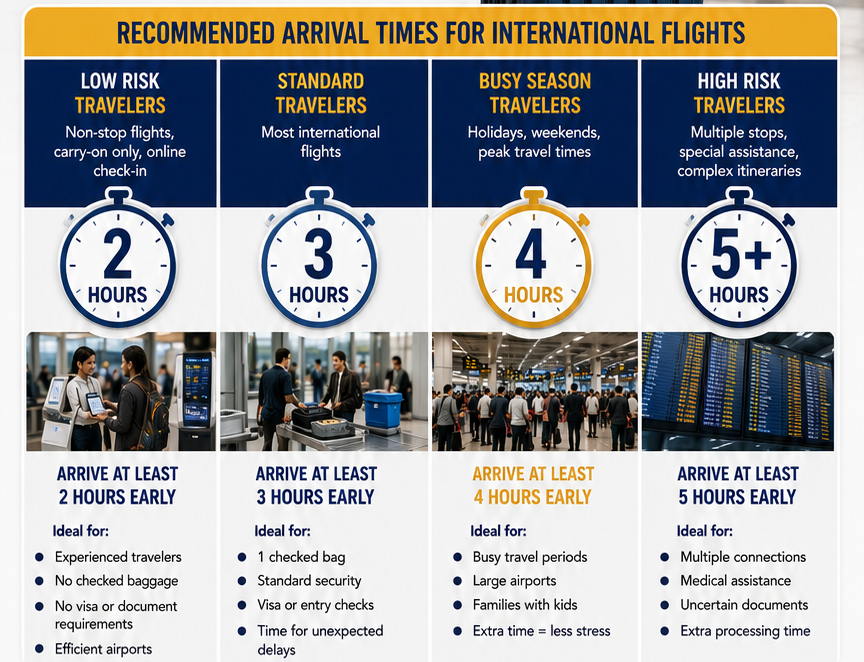
Category 1: Low-Risk Travellers — Arrive at Least 2 Hours Early
You qualify as a low-risk traveller if you have already completed online check-in, you are travelling with carry-on luggage only, your passport and visa requirements are straightforward, and you are flying from an airport that processes passengers efficiently. Under these conditions, arriving two hours before your international flight gives you adequate time to clear security, complete any final document checks, and reach your gate without rushing.
This category suits experienced travellers who know their airport well and have eliminated every potential delay in advance. If your boarding pass is already on your phone, your bag meets carry-on requirements, and your destination requires no visa or only a straightforward ETA already approved, two hours works. If any of those conditions is not fully met, move up to the next category.
Two hours is a minimum, not a target. It leaves very little room for anything unexpected — a long security queue, a terminal transfer, a gate change. If you fall comfortably into this category, two hours is fine. If you have even a small doubt, add thirty minutes.
Category 2: Standard Travellers — Arrive at Least 3 Hours Early
Three hours is the right arrival window for most international travellers on most routes. If you are checking in a bag, if your journey involves visa or entry document checks, if you are flying from a large airport with long security queues, or if your ticket involves any complexity at all, three hours gives you a comfortable buffer without wasting your entire morning at the airport.
This is the category that covers the vast majority of international journeys. A family flying from Heathrow to Dubai. A business traveller heading from Lagos to London. A student flying to Australia for the first time. Three hours allows time for check-in, bag drop, security, immigration departure checks where applicable, and getting to the gate with time to spare.
Do not let the three-hour guidance feel excessive. The time passes faster than you expect once you factor in queuing, walking between terminals, getting something to eat, and finding your gate. The travellers who dismiss three hours as “too much” are often the ones who end up running.
Category 3: Busy Season Travellers — Arrive at Least 4 Hours Early
During peak travel periods — school holiday weeks, Christmas and New Year, Eid, public holiday weekends, summer peak season in July and August — airports operate at or above their designed capacity. Check-in queues grow. Security screening slows down. Bag drop desks have lines stretching across the terminal. Immigration departure queues at certain airports can add forty minutes to an otherwise smooth process.
If you are flying during any recognised busy travel period, add an hour to whatever you would normally allow. Four hours for most travellers, five for complex itineraries. The cost of arriving early during peak season is sitting in a lounge or a café for an extra forty-five minutes. The cost of underestimating the queues during peak season is missing your flight. These two outcomes are not equally bad.
Flying with children adds another reason to give yourself more time. Kids move slower, need bathroom breaks at inconvenient moments, and respond poorly to the stress of rushing through an airport. Build the extra time in for them, not just for you.
Category 4: High-Risk Travellers — Arrive at Least 5 Hours Early
Five hours or more is the right call if your journey involves multiple connections booked separately, if you require special assistance at the airport, if your travel documentation is complex or requires additional verification, or if you have any uncertainty about your paperwork at all.
This category also includes travellers flying through airports with known processing bottlenecks, and anyone travelling on routes where airlines apply extra scrutiny at check-in — for example, certain routes where immigration pre-clearance happens at the departure airport rather than on arrival. If you are unsure which category you fall into, default to the higher end. An extra hour at the airport costs you very little. Missing a flight with complex onward connections can cost you hundreds of pounds and a full day of travel.
What Actually Eats Into Your Time at the Airport
Understanding why airports take as long as they do helps you plan realistically rather than optimistically. Five separate processes stand between arriving at the airport and sitting in your departure seat.
Check-in and bag drop takes between five and thirty minutes depending on the queue and whether you completed online check-in beforehand. Most airlines close check-in between forty-five and sixty minutes before departure for international flights. Miss that window and you do not board, regardless of how early you arrived at the airport overall.
Immigration departure checks apply at some airports and on some routes. Certain countries require departing passengers to pass through an immigration desk before security, where an officer checks your travel document against your ticket and destination. This adds ten to thirty minutes to your departure process and often catches travellers by surprise because it is less common than arrival immigration checks.
Security screening is the most variable part of the process. At a quiet airport on a Tuesday morning, security takes eight minutes. At Heathrow Terminal 3 on the Saturday before Christmas, it can take fifty. You have essentially no control over this once you are in the queue, which is exactly why the time buffer before you get there matters so much.
Walking time within the airport is routinely underestimated, particularly at large international hubs. The distance from the main terminal building to a remote gate at Heathrow, Dubai International, or Istanbul Airport can take fifteen to twenty minutes of walking. Some airports use inter-terminal trains. Knowing your terminal and gate location in advance removes the time you would otherwise spend finding out.
Boarding begins between thirty and forty-five minutes before departure for most international flights and closes ten to fifteen minutes before departure. The gate closes before the plane door closes. Do not confuse the two. If your boarding pass shows a departure time of 14:00, the gate closes at approximately 13:45 to 13:50. You need to be through security and at the gate well before that point, not arriving at it.
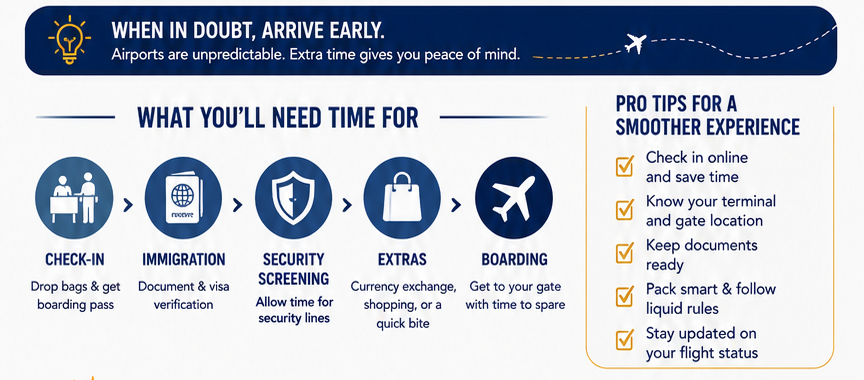
Pro Tips for a Smoother Airport Experience
Check in online the moment check-in opens. Most airlines open online check-in 24 to 48 hours before departure. Doing it immediately after it opens gives you the best seat selection, puts your boarding pass on your phone before you need it, and removes bag drop from the full check-in queue, which is usually much shorter.
Know your terminal and gate before you leave home. Check your airline’s app or a flight tracker like FlightAware the evening before your flight and again on the morning of departure. Gate assignments and terminal information can change, and walking to the wrong terminal at a large airport adds time you may not have.
Keep all your documents immediately accessible. Passport, visa confirmation, boarding pass, travel insurance certificate. Have them in your hand or top pocket when you approach any desk or queue, not buried in a bag you need to unpack. Every minute you spend searching for documents in a queue is a minute someone behind you is visibly impatient about.
Pack your liquids and electronics for fast security screening. Put your liquids in a clear resealable bag and your laptop or tablet at the top of your carry-on so you can remove them quickly at the security tray. Fumbling with a fully packed bag at security is one of the most common causes of unnecessary delay for individual travellers.
Stay updated on your flight status throughout the morning. A delayed departure does not mean you should arrive later. Check your status regularly but still arrive at your planned time. Delays can be revised back to the original schedule faster than you can adjust your departure from home, and arriving late to a newly on-time flight is a very unpleasant situation to be in.
Connecting Your Airport Arrival Time to the Rest of Your Preparation
Getting your arrival time right is one piece of a broader preparation picture. SunnyOnlineTravel’s 48-hour pre-flight checklist covers everything you should sort in the two days before your flight, including online check-in, document preparation, and transport arrangements that feed directly into a smooth departure morning.
If your journey includes a connecting flight, knowing what happens if you miss it is equally important. SunnyOnlineTravel’s guide on what happens if you miss a connecting flight gives you the full picture of your rights and your options before you ever need them. And for those travelling with one-way tickets who may face additional document checks at certain airports, SunnyOnlineTravel’s guide on being denied boarding on a one-way ticket explains exactly what to prepare and why.
For a wider look at how to move through major international airports efficiently from the moment you land to the moment you board, the IATA passenger experience resources and Heathrow Airport’s official passenger guide both offer practical, up-to-date information on specific airport processes.
Your Next Step
Look up your next international flight right now and identify which of the four traveller categories you fall into. Write down your departure time, count back your minimum airport arrival window from that time, then add thirty minutes as a personal buffer on top. Set that time as an alarm on your phone labelled “Leave for airport.” Do this now, before travel day, when you have time to think clearly about transport options and journey time. The travellers who arrive calmly and in control at the airport are not the ones who got lucky. They are the ones who did this calculation well before they needed to rush.


