

AI Flight Price Prediction: Can It Really Tell You When to Buy?
You’ve been staring at a flight price for three days. It went up on Monday. Came down slightly on Wednesday. Then jumped again on Friday. You’re wondering whether to book now or wait, and whether you’ve already missed the best deal that’s going to appear. This is the exact problem AI flight price prediction tools claim to solve, and in 2026, they’ve gotten genuinely good at it. But “genuinely good” is not the same as “perfect,” and knowing the difference could save you hundreds of pounds on your next booking.
Here’s an honest look at how AI flight price prediction works, which tools are worth using, and what they can and can’t actually do for you.
What AI Flight Price Prediction Actually Does
The core promise of AI flight price prediction is straightforward: instead of you guessing when to buy, a machine analyses historical pricing data and current market conditions to tell you whether a fare is likely to go up or down.
Modern platforms analyse billions of pricing signals and travel patterns to help travellers identify cheaper routes, flexible travel dates, and hidden flight deals that would be difficult to find manually. That’s not marketing language. The data sets these tools work with are genuinely enormous. Every fare change, every booking, every route adjustment feeds into models that get recalibrated continuously. iWeaver
The key thing these tools do that you can’t do yourself is pattern recognition at scale. A human can check a fare a few times a day. An AI system tracks millions of fare changes across thousands of routes in real time and spots patterns in that movement that no individual traveller could ever see manually.
Traditional flight search engines show you what is available right now. AI flight finders go further by doing three things conventional tools cannot: price prediction through machine learning models that analyse billions of historical fares, anomaly detection that spots mistake fares and flash sales faster than any human could, and proactive deal alerts that push relevant offers to you before you even start searching. Travo
How the AI Prediction Model Actually Works
Understanding the basic mechanism makes you a smarter user of these tools.
Every airline seat is assigned to a fare class, and as seats in cheaper classes sell, the minimum available price steps up to the next class. AI models learn the typical selling patterns for specific routes at specific times of year, including how fast seats tend to sell, what competitor airlines are charging, and how external factors like local events or school holidays historically affect demand on that route.
Hopper’s algorithms analyse billions of historical flight prices to forecast whether airfare is likely to rise or fall. Instead of booking immediately, Hopper can recommend waiting for a better price or booking right away to secure the lowest fare. The output is a simple “buy now” or “wait” recommendation, backed by a confidence rating that tells you how sure the system is. Fello AI
Flight prices can fluctuate by up to 50%, making it crucial to track them if you want to save money. Booking two to three months in advance often yields the best prices, but AI tools help you identify the optimal window for your specific route rather than following generic advice. The “book two months early” rule works on average across all routes, but averages conceal a lot of variation. A tool that analyses your specific route gives you better guidance than any blanket rule. Dollar Flight Club
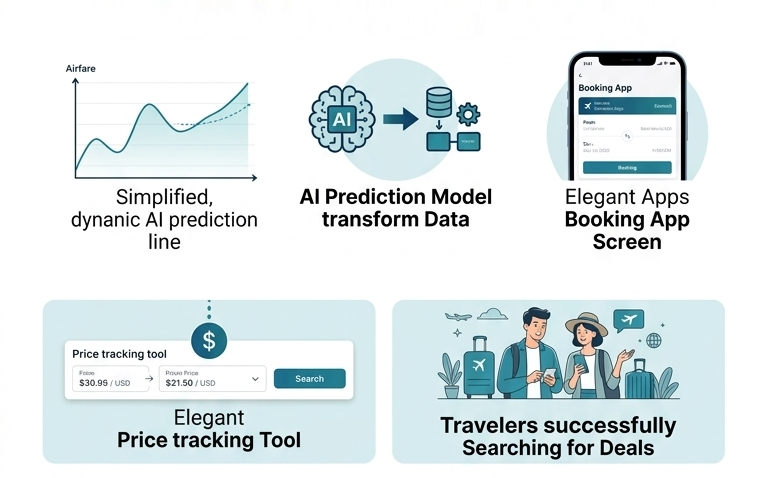
Hopper: The Pioneer of AI Flight Price Prediction
Hopper is the tool most associated with AI flight price prediction, and it has earned that reputation through consistent performance rather than just marketing.
Hopper claims 95% accuracy on price predictions up to a year out and has over 120 million downloads as of 2026. That accuracy claim refers specifically to predicting the direction of price movement, meaning whether a fare will go up or down, not pinpointing the exact price. That distinction matters. Hopper can tell you “this fare is likely to drop, wait three more days” with high confidence. It can’t tell you the fare will drop to exactly £287 on Thursday. Fello AI
Hopper’s algorithms analyse billions of historical prices and claim to save users up to 40% on flights. The app also offers a price-freeze feature that lets you lock in a fare while you decide. The price-freeze feature is particularly useful. If Hopper tells you to wait but you’re nervous about the fare jumping, you can pay a small fee to lock in the current price for a set period. You buy time without committing to the ticket. Travo
Hopper and Google Flights set the pace on accuracy, largely thanks to relentless data crunching and AI enhancements. Hopper’s mobile-first model and price freeze feature give it a slight edge for spontaneous travellers, while Google Flights offers unrivalled transparency and global reach. Both are worth using, and they complement each other rather than compete for the same use case. Futureflights
Google Flights: The Most Powerful Free Tool Available
Google Flights doesn’t brand itself as an AI prediction tool, but it has more price intelligence built into it than most travellers realise.
The calendar view in Google Flights shows you price variations across an entire month at a glance. You can see immediately that flying on a Tuesday costs £180 less than flying on a Saturday, without manually checking each date. The flexible date feature does the same across a much wider range of travel windows.
Google Flight Deals, launched in August 2025 across the US, Canada, and India, returns flights at least 20% below typical prices when you describe your trip in plain English. You can describe a trip conversationally, “I want to go somewhere warm in Europe for a week in October, budget around £400 return” and Google’s AI will surface options that match. That’s a meaningfully different experience from the old model of entering specific dates and airports. Fello AI
Google Flights also shows price history for individual routes, which tells you whether the current fare is high, low, or average relative to what the route has historically cost. That historical context is something Hopper doesn’t provide as transparently, making Google Flights the better tool for understanding whether a price is genuinely good or just appears good because you haven’t seen lower recently.
Google Flights now displays confidence ratings on its price predictions, acknowledging that even the best forecasting tools can offer probabilities rather than certainties. That honesty is worth respecting. Any tool that claims to guarantee you the lowest price should immediately raise your scepticism. Futureflights
Skyscanner and the Price Alert Ecosystem
Skyscanner takes a different approach to AI price prediction. Rather than prompting you to book or wait, it focuses on monitoring and notification.
Skyscanner Price Alert employs real-time AI to track changes in flight prices and predict future changes. Customers can set alerts for specific flights on certain dates and receive notifications when prices drop. The alerts offer price predictions based on history and current market shifts, so travellers know when to book. Triplolo
The practical value of this approach is that it removes the need for you to check prices manually. You identify the routes you care about, set an alert, and let Skyscanner do the watching. When a meaningful drop occurs, you get notified and can decide whether to act.
Start tracking routes two to three months before your trip. Price prediction models are most accurate with a longer observation window. Setting up a Skyscanner alert and a Google Flights alert simultaneously on the same route gives you the best coverage. One notifies you of drops, the other tells you whether to act on them or wait for something better. Travo
The “Going” App: A Different Kind of AI Flight Deal Finder
Going, previously known as Scott’s Cheap Flights, approaches the problem differently from Hopper and Skyscanner.
Instead of searching for flights yourself, Going monitors routes from your home airports and pushes deals to you when fares drop significantly. Their algorithms detect mistake fares, flash sales, and pricing errors faster than any human could. Travo
A mistake fare is when an airline or booking platform accidentally prices a route dramatically below its intended level. These windows often close within hours or even minutes. No human team monitoring flight prices could catch them reliably, but an AI system that watches prices continuously can alert you within seconds of a mistake fare appearing.
Going is best for mistake fares and flash sales; Hopper is best for normal price prediction. If you’re the kind of traveller who can move quickly and has flexible dates, Going is worth adding to your toolkit alongside Hopper. They serve different needs and work best used together. Fello AI
How Accurate Are These AI Predictions Really?
Hopper’s 95% accuracy claim gets repeated often, but it deserves some context before you rely on it completely.
Hopper and other prediction tools can only offer probabilities, not certainties. Even the best airfare prediction tools get blindsided by an airline’s mid-day fare shakeup or a viral social media trend that floods a route with demand. The system learns from historical patterns, but genuinely novel events, a sudden popular destination trend, a news event that disrupts travel to a region, a major airline sale that undercuts the entire market, sit outside those patterns and can make predictions temporarily unreliable. Futureflights
AI can analyse historical pricing, demand trends, and airline behaviour to significantly improve the accuracy of airfare forecasting. However, no tool can guarantee prices. That’s the honest version of the promise. These tools improve your odds significantly. They don’t eliminate the element of chance entirely. ASAP Trips
The most useful way to think about AI flight price prediction is as a probability-improving tool rather than a certainty-creating one. If a tool tells you a fare is very likely to drop and you wait, you’ll be right more often than you would be by guessing. That’s valuable. It’s not the same as being right every time.
When AI Flight Price Prediction Works Best
These tools perform best under specific conditions that are worth knowing before you start using them.
Longer time horizons. Price prediction models are most accurate with a longer observation window. If you’re searching for a flight two weeks out, the model has less data to work with and less time for the predicted movement to materialise. Start tracking three months or more before you want to fly for the best results. Travo
Common, high-frequency routes. AI models learn from historical data. A busy route between two major cities has enormous amounts of historical pricing data to train on. A less-travelled route between smaller cities has less data, which typically means less accurate predictions. Hopper and Google Flights perform best on routes they’ve watched millions of fares move across.
Stable demand periods. During school holidays, major events, or sudden popular destination spikes, the historical patterns these models rely on can break down because demand is running well above normal levels. During those periods, the “book now” signal is usually correct, but the prediction of how much more the price might drop if you wait becomes less reliable.
For a broader approach to booking smarter and managing travel costs, the SunnyOnlineTravel post on how airlines use AI to change your ticket price gives you the full picture of what’s happening on the airline side, which complements what you’re reading here about the tools on your side.
The Best Booking Strategy: Stack Multiple Tools
The travellers who consistently pay less for flights don’t rely on a single tool. They use a small stack of free resources that each do something slightly different.
The recommended workflow is: start with Google Flight Deals for a broad search using plain-English descriptions of your trip, cross-check with Hopper for a buy-or-wait signal, check Going for any mistake fares or flash sales on the same route, and book directly with the airline when prices match. That approach takes about ten minutes and gives you a comprehensive view that no single tool provides alone. Fello AI
Booking directly with the airline is worth emphasising. When you find a price you’re happy with through a comparison tool, visit the airline’s own website and check whether the same fare is available. Airlines sometimes offer lower prices on their own sites to save on the commission they’d pay to third-party booking platforms. If the prices match, the airline direct booking typically gives you easier access to customer service if something goes wrong.
And when things do go wrong with bookings, the SunnyOnlineTravel guide on what happens if you miss a connecting flight covers your rights and options clearly. It’s worth reading before you travel rather than after something has already gone sideways.
Price Tracking Tools: Setting Them Up Properly
A price alert you set up badly gives you noise rather than signal. Here’s how to make them work properly.
Set alerts as early as possible. Tools like Google Flights, Hopper, and Skyscanner help you monitor prices, predict trends, and book at the right time. Booking two to three months in advance often yields the best prices. That window gives the prediction model enough history on your specific route to make meaningful calls. Dollar Flight Club
Set alerts on multiple tools simultaneously, not just one. Google Flights alerts and Hopper notifications cover different aspects of price movement. Having both running costs you nothing and significantly increases your coverage.
Be honest with yourself about your flexibility. AI price prediction tools work best when you can genuinely act on a “buy now” signal within a few hours. If your work schedule, family commitments, or destination requirements mean you can only travel on specific dates regardless of price, some of what these tools offer becomes less useful to you. In that case, the most valuable feature is the price history view, which tells you whether you’re looking at a good or bad price for your fixed dates.
The SunnyOnlineTravel travel checklist for 48 hours before your flight is a useful companion once you’ve booked. Getting the booking right is step one, and this checklist covers the preparation that comes after.
Practical Tips You Can Apply Right Now
Download Hopper before your next search. Hopper has over 120 million downloads and claims 95% accuracy on price predictions up to a year out. It’s free to download and the core prediction features don’t cost anything. Open it, enter your route, and check whether it says buy now or wait before you book anything. Fello AI
Set a Google Flights price alert today for any route you’re considering. Open Google Flights, search your route, and click the bell icon to enable price tracking. You’ll receive email notifications when the fare changes significantly. This is free, takes 30 seconds, and removes the need to check manually.
Set a Skyscanner alert on the same route. Go to Skyscanner, search your route, and enable price alerts. Two alerts on the same route from different tools means you catch more movement without extra effort.
Use the Google Flights date grid before fixing your dates. If you have even a little flexibility, click “flexible dates” in Google Flights and look at the price grid across a month. You’ll often see price differences of £100 or more between adjacent travel dates. Shifting your trip by two days can produce savings a prediction tool can’t match.
Check the price history on Google Flights before you book. When you search a specific route, Google Flights shows a graph of how prices have moved over recent weeks. If the current price sits near a historical low point, that’s a stronger signal to book now than any prediction tool alone.
Use Going (formerly Scott’s Cheap Flights) for routes you’re flexible about. Sign up with your home airport, set your general travel preferences, and let Going push deals to you. You might discover a fare to a destination you weren’t actively considering that’s too good to ignore.
Never book in a panic. AI prediction tools give you information, not urgency. If Hopper says “book now,” take five minutes to cross-check on Google Flights before you commit. A minute of verification is worth it every time.
AI flight price prediction won’t make every booking cheaper, and no tool can promise that. But used correctly, these tools give you a clear advantage over booking on instinct alone. The gap between what an informed traveller pays and what an uninformed one pays on the same route continues to grow as airline pricing gets more sophisticated. These tools are your best response to that gap.
Follow Sunny Online Travel for the practical, honest travel advice that helps you fly smarter and spend less. Save this article, share it with someone who always wonders whether to book now or wait, and set up your first price alert before you close this tab.


