
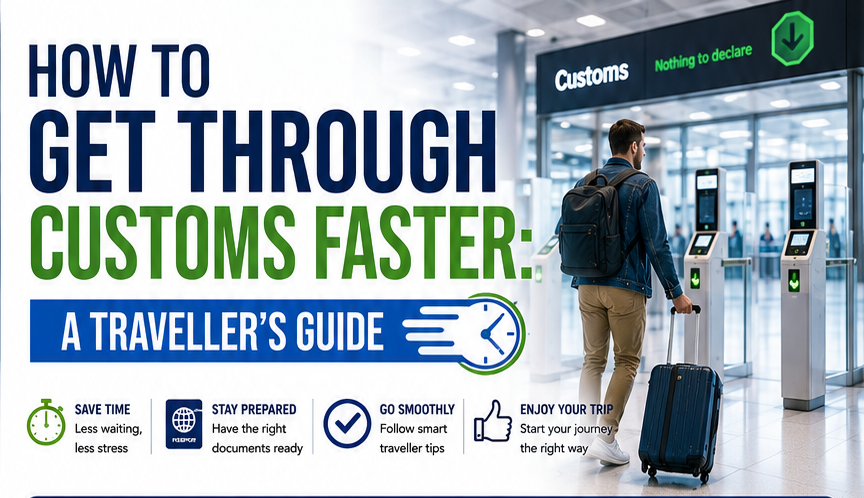
How to Get Through Customs Faster: A Traveller’s Complete Guide
Nobody books a trip and thinks “I can’t wait to spend forty minutes in the customs queue.” Yet for many travellers, that is exactly what happens — and almost always because of things that were entirely avoidable. Learning how to get through customs faster is not about gaming the system or finding shortcuts. It is about preparation. The travellers who sail through customs every single time are not luckier than you. They just know what officers check, what triggers delays, and how to arrive at the border completely ready for every question.
This writeup covers all of it: documents, declarations, e-gates, packing, fast-track lanes, and the attitude that makes a quiet difference. Follow these steps and you will spend less time standing in lines and more time enjoying wherever you have arrived.
How to Get Through Customs Faster: Start Before You Even Board the Plane
The biggest customs delays are caused by things that go wrong before you land, not at the counter itself. Sorting your documents, completing your declaration, and researching entry rules in advance turns a stressful border crossing into a smooth one.
Have Every Document Ready and Accessible
This sounds obvious, but it is the step that slows people down most at customs. Rummaging through a carry-on bag for a passport, pulling up a visa confirmation buried in a cluttered email inbox, or realising you left your arrival card on the plane — all of these add time and create the kind of flustered impression that invites extra questions from officers.
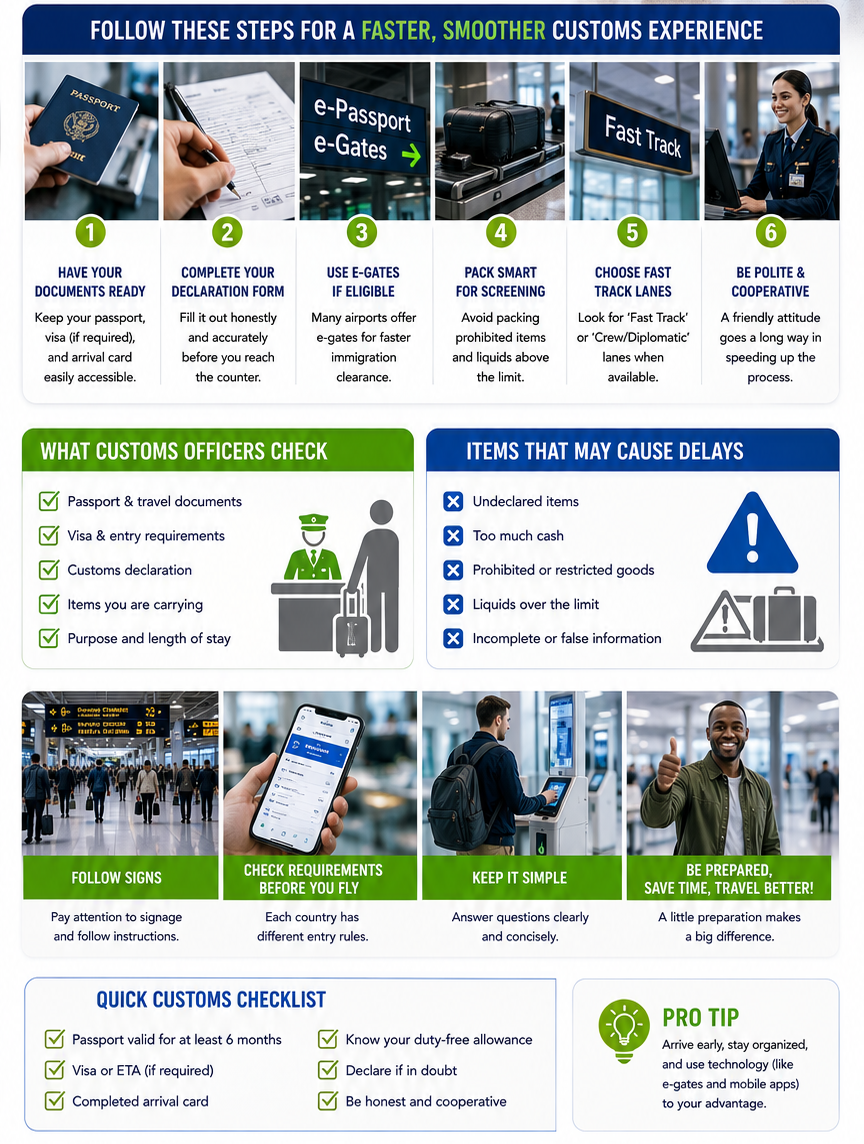
Before you travel, gather everything you might need at the border and keep it all together. Your passport should have at least six months of validity beyond your travel dates. Many countries refuse entry if your passport expires sooner, and airlines check this at check-in anyway. Your visa or ETA, if required, should be confirmed and saved in both your email and your phone’s photo roll. If your destination uses a paper arrival card, fill it in on the plane before you land, not while standing in the customs queue.
Your passport, visa documentation, and arrival card should all be in your hand or your top pocket when you approach the customs counter. The officer should not have to wait while you search for anything.
Complete Your Customs Declaration Honestly and Accurately
Customs declarations exist for a reason, and officers know when they have been filled in carelessly. Fill yours in honestly. If you are unsure whether to declare something, declare it. The consequences of failing to declare a restricted or prohibited item are significantly worse than declaring something you didn’t need to. An honest declaration that prompts a brief conversation with a customs officer takes a few minutes. Getting caught with an undeclared item can mean confiscation, a fine, and in serious cases, a formal record against your passport.
Most countries now offer digital declarations through a mobile app or a kiosk before you reach the counter. Use these wherever they are available. Pre-submitting your declaration online means the officer already has your information when you arrive, which cuts the interaction down significantly.
Use E-Gates and Technology to Get Through Customs Faster
E-Gates: The Single Fastest Way Through Immigration
If your passport is eligible for e-gates at your destination, use them. E-gates use biometric technology to match your face to your passport photograph and process your entry in seconds. No waiting for an officer to flip through your passport, no eye contact, no questions for straightforward arrivals. You walk up, scan your document, look at the camera, and walk through.
Eligibility varies by country and passport type. UK passport holders can use e-gates across most major European airports when entering as tourists, as well as at UK airports on return. Many airports across the US, Australia, Canada, the UAE, and Singapore also operate e-gate systems for eligible travellers. Check whether your destination offers e-gates for your passport before you travel.
One practical note: e-gates sometimes reject biometrics on older passport chips or passports with significant wear. If your passport is more than eight years old or visibly worn, it is worth getting it renewed before a major international trip. A failed e-gate scan sends you back to the standard queue, which costs time you could have saved.
Mobile Apps and Digital Declarations
An increasing number of countries let you complete your customs and immigration declaration via a smartphone app before your flight lands. Australia’s Digital Passenger Declaration, the US Mobile Passport Control app, and similar tools in Canada and New Zealand all allow eligible travellers to submit their information in advance and receive a QR code that speeds up their processing at the border.
IATA’s Travel Centre tool is also worth checking before you fly. It gives passport-specific entry requirement information for virtually every destination, so you know exactly what documents you need and whether any digital pre-registration is available for your route.
Pack Smart to Get Through Customs Faster
Avoid Items That Trigger Bag Checks
The customs screening process slows down when officers need to inspect bags. Certain items trigger additional screening almost every time: liquids over 100ml in carry-on bags, large quantities of cash (most countries require you to declare amounts over $10,000 or the local equivalent), fresh food or plant material, and items that look unusual on an X-ray because of how they’re packed.
Pack your carry-on deliberately. Keep electronics and cables organised and easy to remove for security screening. Do not pack snacks containing fresh fruit, meat, or dairy products unless you are certain they are permitted at your destination. Countries like Australia and New Zealand enforce extremely strict biosecurity rules and actively scan for undeclared food items using detector dogs and X-ray equipment.
Know your duty-free allowance for both your destination and your home country. Bringing back more than your allowance and failing to declare it slows things down and can result in paying duty on arrival — or worse, having items confiscated.
Keep Liquids Organised and Within Limits
The 100ml liquid rule for carry-on bags applies to security screening before your flight, but poorly packed liquids that have leaked or caused residue on other items can also attract scrutiny at customs on arrival. Pack liquids in a clear resealable bag, keep them accessible, and make sure all containers are within the permitted size. This saves time at departure security and keeps your bag clean and inspectable on arrival.
Choose Fast-Track Lanes and the Right Queue
Look for Fast-Track Lanes
Many international airports offer fast-track immigration lanes for premium cabin passengers, airline status holders, or travellers who purchase a fast-track pass separately. If you fly business or first class, your boarding pass almost always grants fast-track access. If you fly economy, check whether the airport sells a fast-track pass as an add-on — at busy airports like Heathrow, JFK, or Dubai International, this can be worth every penny of the small additional cost during peak travel periods.
Also look for dedicated lanes based on your arrival type. E-gate lanes, e-passport lanes, and crew or diplomatic lanes are separate from the general queue. At a large international hub, the difference between the right lane and the wrong one can be thirty minutes or more during a busy arrival bank.
Be Polite and Cooperative — It Genuinely Speeds Things Up
This is the tip people discount most, and it is one of the most effective. Customs officers process hundreds or thousands of travellers every shift. A traveller who is calm, prepared, answers questions clearly, and does not argue speeds their own process up considerably. A traveller who is defensive, vague, or argumentative gets more questions and longer scrutiny.
Answer what you are asked, nothing more and nothing less. Do not volunteer information that was not requested. If you are asked the purpose of your visit, give a short clear answer: tourism, business, visiting family. Do not give a lengthy explanation that raises more questions than it answers. Eye contact and a relaxed demeanour tell an officer very quickly that you have nothing to hide.
What Customs Officers Actually Check
Understanding what officers look for helps you prepare to satisfy those checks as quickly as possible. A customs officer at the border is reviewing five things: your passport and travel documents, your visa and entry requirements, your customs declaration, the items you are carrying, and your stated purpose and length of stay.
For most straightforward leisure travellers, all five of these checks take less than two minutes when documents are in order. The checks slow down when any of these five areas raise a question. Your job at the border is to arrive with every answer already sitting in your hand or your bag.
The UK Border Force’s guidance for travellers explains exactly what UK officers check and what travellers should prepare for when returning to the UK. If you’re arriving in the US, the US Customs and Border Protection official site gives a clear breakdown of what to expect at an American border.
The Quick Customs Checklist Every Traveller Should Use
Run through this before every international trip, not just once a year.
Your passport should be valid for at least six months beyond your travel dates. Confirm your visa or ETA is approved and accessible digitally and in print. Complete your arrival card on the plane. Know your duty-free allowance for both your destination and your home country. Declare anything you are uncertain about rather than hoping it passes unnoticed. Be honest, be calm, and be cooperative throughout the process.
Preparation takes ten minutes at home. It saves thirty minutes at the border. That is one of the best time trades in travel.
For more on setting yourself up well from the moment you step into the airport, SunnyOnlineTravel’s 10 airport tips for stress-free travel gives practical guidance that applies from check-in all the way through to arrivals. If your journey involves a connecting flight at an international hub, SunnyOnlineTravel’s guide on what happens if you miss a connecting flight covers exactly what to do and how to protect yourself. And for those travelling on one-way tickets who face additional scrutiny at borders, SunnyOnlineTravel’s guide on being denied boarding on a one-way ticket explains the risk and how to manage it confidently.
Your Practical Points
The evening before your next international flight, do one thing: take out your passport and check the expiry date right now. If it expires within six months of your travel dates, start a renewal application today. Then check your destination’s customs declaration requirements and download the relevant app if one is available for your route. Walk into the airport tomorrow with your passport, visa confirmation, and completed declaration accessible from the moment you arrive. That single act of preparation removes the most common causes of customs delays and puts you in the fastest lane before you even reach the border


